
- All
- Product Name
- Product Keyword
- Product Model
- Product Summary
- Product Description
- Multi Field Search
Views: 88 Author: Site Editor Publish Time: 2026-04-29 Origin: Site


Wire harness processing involves multiple stages, from cutting and stripping wires to soldering, crimping, and applying insulation. Among these, the correct handling of heat shrink tubing—cutting it to precise lengths and baking it to form a secure, insulated seal—is critical for product quality and reliability. Many manufacturers still rely on manual methods or single‑function machines, which often lead to low efficiency, inconsistent results, and high defect rates.
Choosing the right equipment for heat shrink tube cutting and baking directly impacts production speed, accuracy, and long‑term cost control. This guide explains the key functions of these machines, what to look for when selecting them, and how they integrate into modern wire harness processing lines.
Wire harness processing requires specialized equipment for cutting and baking heat shrink tubing.
Heat shrink tube cutting machines improve speed and precision over manual cutting, reducing burrs and waste.
Heat shrink tube baking machines with multi‑station synchronous heating dramatically increase throughput and consistency.
Equipment should offer adjustable length, temperature control, and quick changeover for different tube sizes.
Automation reduces labor costs, defect rates, and rework, making it a worthwhile investment for most harness producers.
Heat shrink tubing is used to insulate, protect, and strain‑relieve wire connections. After a wire is soldered or crimped to a terminal, a piece of heat shrink tube is placed over the joint and heated. The tube shrinks tightly around the wire, creating a durable, moisture‑resistant seal. Common applications include automotive electronics, consumer electronics, new energy vehicles, smart home devices, and industrial control systems.
To process heat shrink tubing efficiently, two main types of equipment are needed: a cutting machine to cut tubes to exact lengths, and a baking machine to shrink the tubes onto the wires.
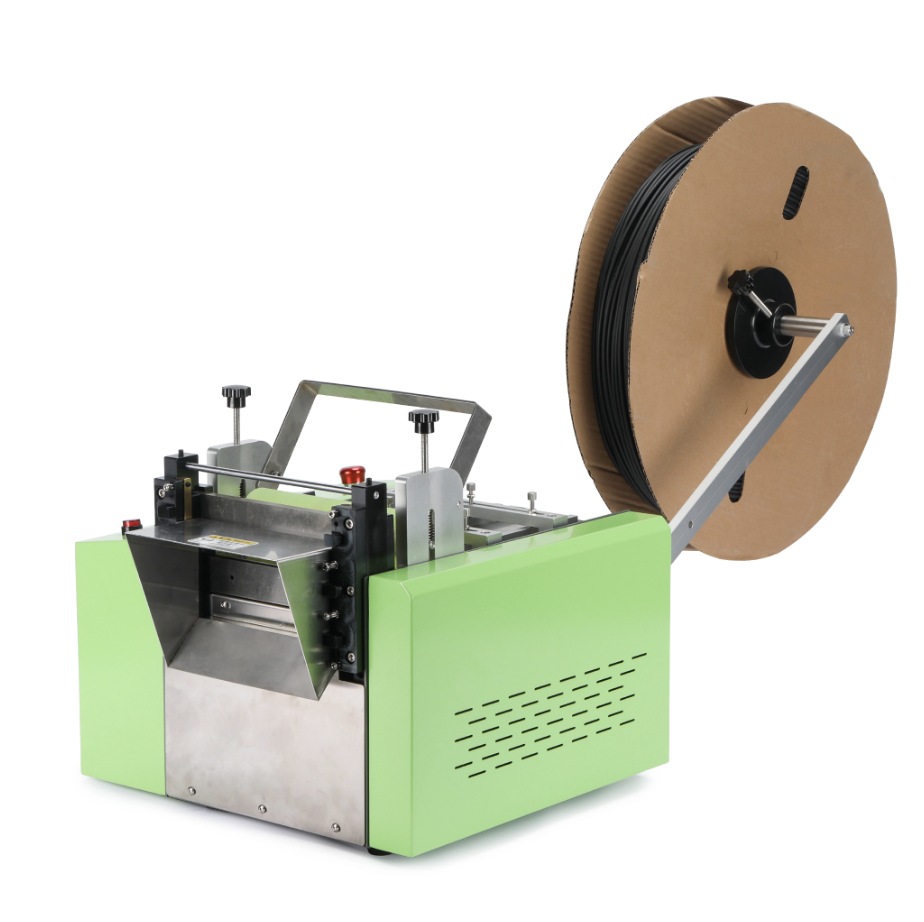
Manual cutting of heat shrink tubing with scissors or hobby knives is slow, inaccurate, and often leaves burrs or angled cuts. Inconsistent lengths lead to poor sealing or exposed conductors. For high‑volume production, a dedicated heat shrink tube cutting machine is essential.
Multi‑tube synchronous cutting – Cuts several tubes simultaneously, dramatically increasing throughput.
Micron‑level precision – Ensures cut length error ≤0.1mm, with burr‑free and perpendicular ends.
Adjustable length range – Supports tube lengths from a few millimeters to several hundred millimeters, with digital setting.
Quick changeover – One‑key adjustment for different tube diameters and lengths, reducing downtime.
Durable blades – Tungsten steel or similar material provides long service life.
Consider your daily tube consumption, required length tolerance, and variety of tube sizes. A machine with multi‑tube synchronous cutting and quick changeover will serve most medium‑to‑high volume lines well. For small batches, a single‑tube automatic cutter may still offer significant gains over manual methods.
Manual baking using a heat gun is inconsistent. Operators may overheat or underheat the tube, causing cracks, incomplete shrinkage, or burnt insulation. Single‑station automatic machines improve consistency but still limit throughput. For larger batches, a multi‑station synchronous baking machine is the preferred solution.
Multi‑station synchronous heating – Bakes many tubes at the same time, boosting throughput dramatically compared to single‑station machines.
Precision temperature control – ±1°C accuracy ensures uniform shrinkage without damaging tubes or wires.
Adjustable temperature range – Typically 80–150°C, covering most heat shrink materials.
Customizable fixtures – Accommodates round, flat, or special‑shaped wire harnesses.
Touchscreen interface – Allows easy parameter setting, real‑time monitoring, and fault alerts.
Assess your batch size and required processing speed. A multi‑station machine will quickly pay for itself in labor savings and reduced defect rates if you process thousands of tubes daily. For lower volumes, a smaller oven with good temperature uniformity may suffice.
While heat shrink handling is critical, a complete wire harness processing line may also include:
Wire cutting and stripping machines – to cut wires to length and remove insulation.
Terminal crimping machines – to attach connectors.
Soldering machines – for precise connections.
These machines should be selected based on wire gauge, production volume, and desired automation level. For small to medium batches, semi‑automatic desktop models are often cost‑effective and flexible.
Your daily tube consumption will guide the level of automation. Low volumes may still benefit from manual tools, but as volume increases, automatic cutters and bakers become essential for maintaining throughput and quality.
Verify that the equipment handles your tube diameter range (e.g., 1–20mm), material type (polyolefin, PVC, PTFE), and required length tolerance. A machine with ≤0.1mm precision is recommended for most commercial applications.
If you process multiple tube sizes or lengths daily, quick changeover (under 5 minutes) is critical. Look for digital presets and tool‑less adjustments to minimize downtime.
Desktop machines are standalone and easy to add. For continuous flow, ensure the cutter and baker can be placed at convenient stations in your production line.
A cheaper machine may have higher defect rates, shorter blade life, and limited support. Prioritize equipment with low defect rates, long‑lasting components, energy efficiency, and reliable after‑sales service.
Automotive electronics – Sensor harnesses, engine wiring – requires high precision and vibration‑resistant seals.
New energy – Battery pack harnesses, charging cables – demands high throughput and consistent insulation.
Smart home – Internal connecting wires – benefits from fast changeover for multiple product types.
Consumer electronics – Charging cables, earphone wires – needs burr‑free cuts and compact design.
Medical devices – Catheter assemblies, sterile tubing – requires clean cuts and precise temperature control.
Industrial control – Control panels, automation wiring – values durability and low defect rates.
Wire harness processing does not require the entire cable production line of drawing, extrusion, and armoring. What most manufacturers need is reliable heat shrink tube cutting and baking equipment that delivers precision, speed, and consistency. Manual methods cannot keep up with modern quality and volume demands. Automated solutions – especially multi‑tube synchronous cutters and multi‑station synchronous bakers – offer a clear path to higher efficiency, lower labor costs, and reduced defect rates.
When selecting equipment, evaluate your daily volume, tube specifications, changeover needs, and total cost of ownership. Choosing a manufacturer with proven expertise, such as EPACK, can help ensure your harness processing line runs smoothly and profitably.
Q: What is the difference between a heat shrink tube cutter and a regular blade cutter?
A: A dedicated heat shrink tube cutter uses servo‑driven feeding and high‑precision blades to produce clean, perpendicular cuts without burrs or deformation. Regular cutters tend to crush or angle the tube.
Q: How fast is a typical automated heat shrink tube cutting machine?
A: Single‑tube cutters operate at 30–60 cuts per minute. Multi‑tube synchronous cutters can achieve much higher effective throughput by cutting several tubes in parallel.
Q: Do I need a baking machine if I already have a heat gun?
A: For occasional repairs, a heat gun may suffice. For production, a baking machine ensures uniform temperature, faster processing, and consistent results – typically reducing defect rates from a few percent to below 0.5%.
Q: Can the same baking machine handle different tube diameters?
A: Yes, with appropriate fixtures. Many machines support a standard diameter range, and custom fixtures are available for non‑standard tubes or special shapes.
Q: Is EPACK’s heat shrink equipment easy to operate?
A: Yes. Both cutters and baking machines feature touchscreen interfaces with preset options. New operators can learn quickly, and automatic fault alerts simplify troubleshooting.
Q: What certifications does EPACK equipment have?
A: CE, RoHS, and manufactured under ISO 9001 quality management – suitable for export to regulated markets.


