Every shipping decision shapes your bottom line directly. epack packaging choices dictate dimensional (DIM) weight shipping costs. They influence product damage rates and determine fulfillment velocity. A poor choice drains profit margins quietly but consistently. Selecting the right solution requires moving beyond basic per-unit box costs. You must evaluate comprehensive operational expenses. System scalability and supply chain reliability demand equal attention. Ignoring these hidden factors leads to bloated shipping budgets. It also frustrates your warehouse teams during peak seasons. This guide provides a vendor-neutral, evidence-based framework. We will help you evaluate and shortlist epack packaging solutions tailored to your specific operational needs. You will learn how to audit baseline metrics effectively. We show you how to compare material categories and deploy changes smoothly onto your warehouse floor.
Key Takeaways
- Success requires a TCO approach: Per-unit packaging costs often mask the hidden expenses of fulfillment labor, storage footprint, and DIM weight penalties.
- Align materials with product fragility: Avoid over-packaging by utilizing standardized transit testing (e.g., ISTA protocols) to validate material choices.
- Operational friction is the biggest risk: A new epack packaging solution must integrate with your current fulfillment workflows without causing packer slowdowns.
- Scalability hinges on vendor reliability: Prioritize suppliers with transparent lead times, redundant manufacturing, and realistic minimum order quantities (MOQs).
Framing Your Business Problem and Success Criteria
Before you select a new epack packaging solution, you must understand your current baseline. This requires a strict audit of existing operations. You cannot improve what you do not measure accurately.
Audit Current Baseline Metrics
Begin your evaluation by defining current damage rates. Look at customer return logs to pinpoint transit-related breakage. Categorize these damages by product type and transit zone. Next, calculate the average packaging time per order. Stand on the warehouse floor. Time your packers using a stopwatch across different shifts. Document the exact time spent folding, taping, and inserting void fill. Finally, determine your baseline DIM weight costs. Analyze courier invoices from the past six months thoroughly. Identify specific packages penalized for excessive size. Calculate the exact premium you pay for shipping empty air.
Define Success Thresholds
Vague goals yield poor implementation results. Establish hard, numerical targets for the new epack packaging system. Do you want to reduce void fill usage by 20%? Perhaps you need to cut transit damages to under 1% for fragile items. Another valid goal involves transitioning entirely to curbside recyclable materials. You must document these thresholds clearly. They serve as your vendor scorecard later in the procurement process. Without strict targets, buyers often succumb to subjective aesthetic preferences over raw operational performance.
Identify Fulfillment Constraints
Your physical warehouse environment dictates your packaging flexibility. Document your specific physical storage limits. Some facilities lack pallet racking for storing bulky, pre-assembled boxes. Assess your exact ratio of automated packing to manual packing. Automated machines require highly specific material tolerances. They jam easily if cardboard thickness varies slightly. Consider your peak season volume spikes carefully. During Q4, you need packaging materials you can assemble rapidly. Slower assembly times multiply quickly when daily order volumes triple. Avoid complex box structures if temporary holiday staff will assemble them.
Core Epack Packaging Categories: Matching Solution to Strategy
Vendors offer numerous options, but they fall into distinct categories. You must align these categories directly to your product types and shipping profiles.
Stock vs. Custom Form Factors
Many brands debate fiercely between stock and custom boxes. Stock materials provide significantly faster lead times. They also carry much lower minimum order quantities (MOQs). This makes them excellent for standardized goods or startups testing new markets. Custom materials demand higher upfront tooling costs. However, they optimize strict DIM weight reduction perfectly. Custom designs also create premium unboxing experiences for high-value items. You must balance the initial capital outlay against long-term shipping savings.
Comparison of Stock vs. Custom Form Factors
| Feature | Stock Packaging | Custom Packaging |
| Lead Time | 1 to 3 days | 4 to 8 weeks |
| Minimum Order Quantity (MOQ) | Low (e.g., 50 units) | High (e.g., 1,000+ units) |
| DIM Weight Optimization | Poor to Average | Excellent |
| Upfront Tooling Costs | None | High (Die plates, printing plates) |
| Brand Experience | Generic and Standardized | Premium and Memorable |
Material Types and Protective Approaches
Your choice of material defines the ultimate protection level. Corrugated solutions remain the gold industry standard. They offer heavy, rigid protection for fragile or heavy goods. Flexible packaging, like mailers or poly pouches, serves a different purpose entirely. They are ideal for non-fragile apparel or soft goods. Using mailers drastically reduces shipping costs. They consume virtually no dimensional weight. Eco-engineered alternatives are gaining rapid market share globally. Options include molded pulp, mushroom packaging, and post-consumer recycled (PCR) plastics. Consider these protective options based on specific product profiles:
- Rigid Electronics: Require double-wall corrugated boxes paired with anti-static foam inserts.
- Soft Apparel: Perform best in flexible, tear-resistant poly or kraft mailers.
- Glass Cosmetics: Demand molded pulp trays or honeycomb paper wraps to prevent shatter impact.
You must weigh sustainability goals against realistic durability limits. Mushroom packaging handles shocks well. However, it struggles in high-moisture environments. Always test alternative materials rigorously before deploying them across your entire product catalog.
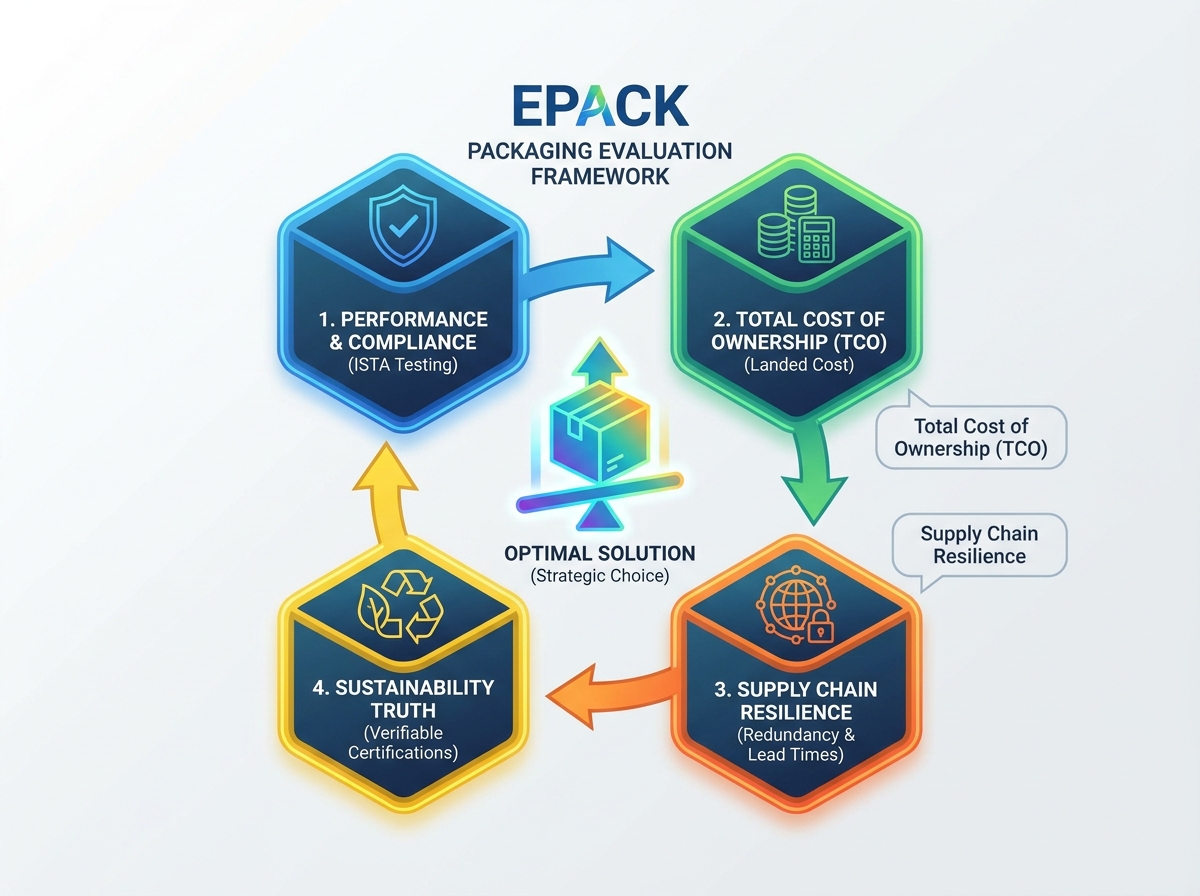
The 4-Point Evaluation Framework for Packaging Vendors
Selecting a supplier demands a highly rigorous vetting process. Use this four-point framework to filter out underperforming vendors early.
1. Performance and Compliance (Features-to-Outcomes)
Never trust verbal assurances regarding product protection. Look for verifiable, independent transit testing data. Ask if the vendor utilizes ISTA testing standards. The International Safe Transit Association provides precise protocols to prove drop and vibration resistance. A reliable epack packaging supplier provides formal certification reports. These reports confirm their materials survive real-world logistics networks. They test for compression strength, edge crush resistance, and rotational drops.
2. Evaluating Landed Costs and Labor
Per-unit price tags deceive many inexperienced buyers. You must calculate the true, holistic landed cost. Include the freight costs required to ship the packaging to your facility. Factor in the warehouse racking space it consumes monthly. Most importantly, measure the labor seconds required to assemble the unit. A box saving ten cents might cost thirty cents in extra packer labor. Focus strictly on comprehensive operational expenses rather than isolated material costs. Every second spent wrestling with complex tape slows down your daily throughput.
3. Supply Chain Resilience
Material shortages disrupt global fulfillment operations constantly. Assess the vendor’s manufacturing redundancy closely. Ask them directly about raw material sourcing risks. Do they rely entirely on a single paper mill overseas? Request guaranteed lead times during Q4 or peak seasonal spikes. You need suppliers who maintain strategic buffer stock. They should guarantee deliveries even when broader supply chains stumble. Ask for references from clients who navigated recent supply shortages successfully alongside them.
4. Sustainability Truth vs. Greenwashing
Marketing teams frequently exaggerate eco-friendly product claims. Demand verifiable, third-party environmental certifications. Look for FSC-certified paper or BPI-certified compostable labels. Reject vague promotional terms like "earth-friendly" or "green." Your customers increasingly recognize and punish greenwashing. Authentic sustainability requires transparent, rigorous validation. Ask vendors for explicit end-of-life disposal instructions for their materials. If a consumer cannot recycle it easily at home, its practical sustainability value plummets.
Implementation Realities: Adoption Risks and Operational Friction
Procuring the right materials solves only half the operational puzzle. You must deploy them onto the warehouse floor smoothly. They must not disrupt your current operations.
The Fulfillment Bottleneck
Evaluate how easily workers assemble the new epack packaging. Complex custom inserts look beautiful but slow down the packing line severely. Every additional fold, tuck, or tab increases pack times. This inflates your variable labor costs dramatically. Conduct time-motion studies on the new structural designs. Compare their assembly times directly against your legacy materials. Simplify structural designs wherever possible. Keep the fulfillment line moving quickly, especially during volume spikes.
Storage and Footprint
Space remains a premium, expensive asset in any fulfillment center. Assess whether the new solution ships entirely flat. Voluminous materials like traditional bubble wrap consume massive racking space. They force you to order more frequently. Some protective solutions require on-demand inflation machines. These machines save vital storage space. However, they require dedicated, powered workstations. Map out your packing floor plan carefully before receiving the first bulk delivery. Ensure you have adequate power drops and ergonomic space for new equipment.
Staff Training and Change Management
Change introduces temporary friction inevitably. Plan for a brief dip in fulfillment velocity. Warehouse staff need time to adapt to new packing SOPs. Introducing new equipment like water-activated tape dispensers requires proper operational training. Automated void-fill machines also demand basic maintenance knowledge. Create clear, highly visual packing guides. Hang these laminated guides directly at every packing workstation. Supervise the initial rollout closely on the floor. Correct bad packing habits early before they become entrenched routines.
Building Your Shortlist and Next-Step Actions
Theoretical evaluations must eventually meet harsh physical reality. Follow these exact steps to finalize your vendor selection safely.
Requesting Samples and Prototypes
Digital renders look flawless on a computer screen. Never commit to bulk orders based on a 3D PDF. Request physical samples immediately from your shortlisted vendors. Test the actual product fit using your most common SKUs. Check the structural integrity by dropping the packed box onto concrete. Assess the print quality and brand color accuracy under typical warehouse lighting. Physical prototypes reveal hidden design flaws instantly. They prevent catastrophic mistakes on large production runs.
Conducting a Pilot Run
Do not transition your entire fulfillment operation overnight. Roll out the top-choice epack packaging on a localized subset of shipments first. Target 500 to 1,000 orders for this controlled initial test. Send these pilot packages to diverse geographic regions intentionally. This exposes the materials to different climate conditions. It tests them against various courier handling styles. A box surviving a local delivery might crush during cross-country transit.
Tracking the Pilot Data
Data drives the safest final decisions. Monitor the pilot run carefully for unexpected spikes in customer damage reports. Audit your courier invoices rigorously for the pilot batch. Look for unexpected shipping surcharges related to inaccurate package dimensions. Gather direct, unfiltered feedback from the packing floor. Ask workers if the new materials cause hand fatigue or unexpected slowdowns. Adjust the box design based precisely on this real-world feedback.
Finalizing the SLA
Once the pilot succeeds, establish binding commercial terms. When finalizing the SLA, ensure you explicitly define these four parameters:
- Defect Tolerances: Establish the maximum acceptable percentage of misprinted or structurally flawed units per batch.
- Lead Time Guarantees: Set firm delivery windows and financial penalties for late arrivals.
- Volume Tiers: Lock in price breaks as your order volumes scale upward over time.
- Buffer Stock Agreements: Require the vendor to hold a specific percentage of inventory locally for emergency replenishment.
A strong SLA protects your operations when unexpected disruptions occur.
Conclusion
Optimizing your fulfillment strategy requires a highly balanced approach. The optimal epack packaging solution sits at the intersection of adequate product protection, streamlined fulfillment labor, and optimized shipping costs. Focus heavily on practical warehouse realities rather than flashy designs alone. Stay objective throughout the procurement process. Rely on physical transit testing over polished sales pitches. Track your courier invoices aggressively to verify DIM weight savings. Finally, treat your packaging choices as a strategic operational function rather than an afterthought. By prioritizing efficiency and reliability, you protect your margins and deliver a superior customer experience simultaneously.
FAQ
Q: What is the standard lead time for transitioning to a new epack packaging provider?
A: Timelines depend entirely on customization levels. Transitioning to stock packaging typically takes two to four weeks. If you require custom tooling, printing, and formal transit testing, expect an eight to twelve-week process. Always factor in an extra two weeks for physical prototyping and pilot testing before committing to full production runs.
Q: How does custom epack packaging affect DIM weight pricing?
A: Couriers bill based on the greater of actual weight or dimensional weight. Custom designs eliminate unnecessary empty space. Shaving even a half-inch off your box dimensions can drop packages into a cheaper courier billing tier. This small reduction frequently yields massive cumulative savings across thousands of shipped orders.
Q: Should I prioritize recyclable or compostable packaging?
A: Recyclability usually proves more practical for end-consumers. The success of compostable materials depends heavily on local municipal waste infrastructure, which varies widely. Many consumers lack access to industrial composting facilities. Standard curbside recyclable materials ensure a higher likelihood of proper disposal, aligning better with broad sustainability goals.
Q: What is an acceptable minimum order quantity (MOQ) for custom packaging?
A: MOQs vary significantly based on the material type and the chosen printing method. For custom structural designs and flexographic printing, minimums typically start between 1,000 and 5,000 units. Digital printing allows lower MOQs, sometimes starting around 250 units, but usually carries a higher per-unit cost.


