
- All
- Product Name
- Product Keyword
- Product Model
- Product Summary
- Product Description
- Multi Field Search
Views: 88 Author: Site Editor Publish Time: 2026-04-08 Origin: Site


Round bottle labeling is a common but technically demanding task. Unlike flat surfaces, round containers require controlled rotation to ensure labels are applied without wrinkles, bubbles, or misalignment. For many small to medium‑scale businesses, a fully automatic labeling line is too expensive or unnecessary. A semi‑automatic labeling machine offers a practical balance: it automates label peeling and application while keeping manual loading and final inspection.
But how do you choose the right round bottle labeling machine for your operation? This guide walks you through the key selection criteria—bottle characteristics, production volume, accuracy requirements, and budget—so you can make an informed decision.
Start with your bottles: diameter, height, and material determine machine compatibility.
Match speed to volume: semi‑automatic machines typically label 40–60 bottles per minute, 4x faster than manual.
Accuracy matters: look for ≥95% placement consistency with adjustable centering systems.
Consider future needs: a flexible labeling machine handles multiple bottle sizes and label types.
Manufacturer support: choose a supplier with in‑house production, certification, and after‑sales service.
Even within the category of round bottles, there are wide variations. Before selecting a round bottle labeling machine, you must know:
Diameter range: what is the smallest and largest bottle diameter? Common ranges are 20–120mm. The machine’s roller and guide system must adjust to both ends.
Height range: from 30ml vials to 1L containers, heights can vary from 40mm to 300mm. Ensure the machine has vertical adjustment.
Material: glass, PET, PP, aluminum cans, steel tins. Different materials require different pressure and adhesive compatibility. A good labeling machine allows pressure adjustment.
Surface texture: smooth or textured? Some cosmetic bottles have delicate finishes that require non‑abrasive applicators.
Selection tip: Choose a machine with tool‑free adjustable guides and a centering system that automatically aligns the bottle regardless of small diameter variations.
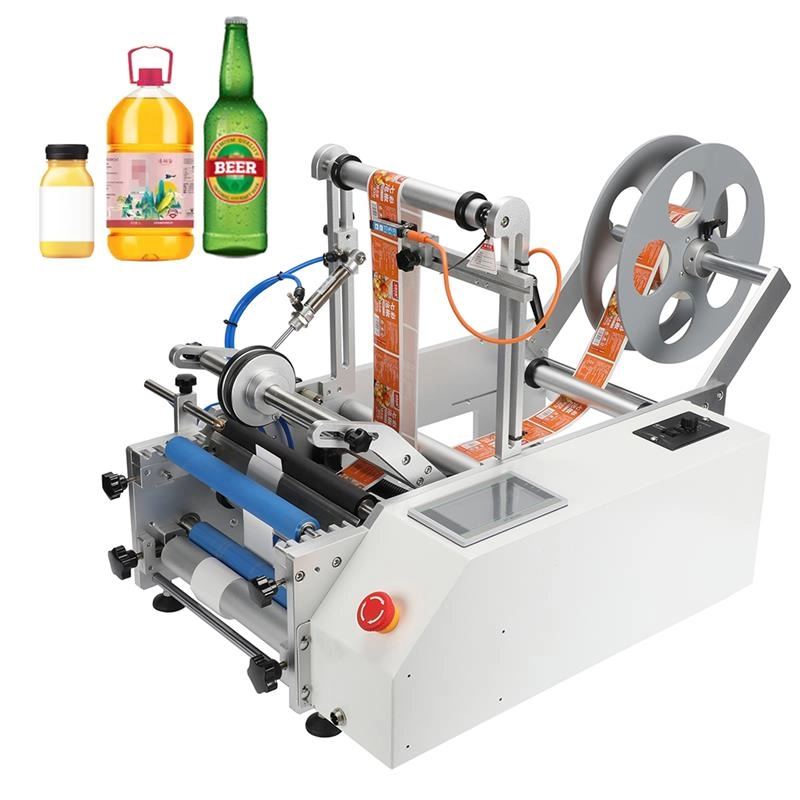
Your daily or hourly output directly influences the type of labeling machine you need.
| Production Volume | Recommended Labeling Method | Typical Speed |
|---|---|---|
| <500 bottles/day | Manual or semi‑automatic | ≤15 labels/min |
| 500–3,000/day | Semi‑automatic | 40–60 labels/min |
| >3,000/day | Fully automatic (conveyor integrated) | 100–300 labels/min |
For most small to medium businesses (craft beverage, cosmetics, pharmaceutical trial batches, specialty foods), a semi‑automatic round bottle labeling machine is the sweet spot. It offers 4x the speed of manual labeling (60+ labels/min) without the complexity and cost of a fully automatic line.
Selection tip: If you are currently labeling manually and spend more than two hours per day on labeling, upgrading to a semi‑automatic machine typically pays back within three to six months through labor savings alone.
Each type of labeling machine serves a different operational scenario. Use this comparison to see where you fit.
| Factor | Manual | Semi‑Automatic | Fully Automatic |
|---|---|---|---|
| Speed (labels/min) | ≤15 | 40–60 | 100–300 |
| Accuracy | <80% | ≥95% | ≥99% |
| Labor per shift | 1 operator fully occupied | 1 operator (can handle 2 machines) | Minimal (monitoring only) |
| Changeover time for different bottles | Low (few seconds) | Medium (2–5 min) | High (10–30 min) |
| Upfront investment | Very low | Moderate ($1,000–5,000) | High ($15,000+) |
| Floor space | Negligible | Desktop (≈0.5㎡) | Requires conveyor line |
| Best for | Occasional labeling, hobby | Small to medium batches, varied products | High‑volume, single product long runs |
Selection tip: If you run more than three different bottle sizes per week, a semi‑automatic labeling machine is more flexible than fully automatic. If you run only one bottle size at very high volume, consider automatic.
Accuracy is non‑negotiable for round bottles because the curved surface magnifies any misalignment. When evaluating a round bottle labeling machine, look for these features:
A mechanical centering system (spring‑loaded or cam‑driven) ensures each bottle is positioned exactly the same way before labeling. This is more reliable than relying solely on the operator’s eye.
The machine should have rollers that can be moved inward or outward to match bottle diameter. Quick‑adjust knobs or levers are preferable to tools.
The label is automatically peeled from the backing paper and held ready. When the bottle rotates, the label transfers smoothly. The system must handle different label lengths (from small perfume labels to full wrap‑around beverage labels).
One advantage of a semi‑automatic labeling machine is that the operator can apply a final roller press. This removes air bubbles and ensures adhesion on curved surfaces—especially important for metallic or transparent labels.
The frame should be steel or reinforced aluminum. Light plastic machines vibrate during operation, reducing accuracy.
Selection tip: Ask the manufacturer for an accuracy test report (e.g., ISO‑based). A claimed 95%+ accuracy should be verifiable.
Not all labels work the same on all labeling machines. You need to confirm compatibility with:
Label roll dimensions: inner core diameter (typically 76mm), outer diameter (up to 300mm), and label width.
Label material: paper, clear BOPP, metallic film, or kraft paper. Thick or stiff materials require stronger peeling force.
Adhesive: permanent, removable, or low‑temperature (for chilled products). The machine’s roller and applicator must not cause adhesive bleed.
Some semi‑automatic labeling machines allow adjustment of peeling speed and pressure. This is valuable if you switch between label types frequently.
The labeling machine is only as good as the manufacturer behind it. When shortlisting suppliers, consider:
Are they a factory or a trader? A manufacturer (like EPACK) offers better pricing, direct technical support, and faster spare parts.
Certifications: ISO 9001, CE, and any industry‑specific standards (e.g., GMP for pharma).
Customization: Can they modify guide rails, add a date coder bracket, or brand the machine with your logo?
Warranty and after‑sales: Look for at least 1‑year warranty and a responsive support team.
Lead time: Stock semi‑automatic machines can ship within 3–10 days; custom orders take 2–3 weeks.
Selection tip: Request a video demonstration or sample labeling test before purchasing. A reputable round bottle labeling machine manufacturer will provide this.
| Your Situation | Recommended Machine Type | Why |
|---|---|---|
| Start‑up, very low budget, occasional labeling | Manual (temporary) | Lowest cost, but upgrade soon |
| Craft beverage, small cosmetics, daily batches | Semi‑automatic round bottle labeling machine | Best balance of speed, accuracy, and cost |
| Pharmaceutical trials, multiple bottle sizes | Semi‑automatic with tool‑less adjustment | Frequent changeovers – avoid automatic |
| High‑volume water bottling (single bottle type) | Fully automatic with conveyor | Maximize throughput |
| Mobile labeling or very small workshop | Desktop semi‑automatic | Compact, no air supply needed |
Buying based only on price – Very cheap machines use weak motors and poor centering, leading to frequent misalignment and rework.
Ignoring bottle variation – If your machine cannot handle your largest and smallest bottles, you will need two machines later.
Over‑automating – A fully automatic labeling machine sounds impressive, but for mixed product lines, changeover downtime kills efficiency.
Forgetting about label roll compatibility – Always check the maximum label roll diameter and core size. Some machines only take small rolls.
Not testing before purchase – A video test with your own bottle and label sample is essential.
Choosing the right semi‑automatic labeling machine for round bottles is a structured process. Start with your bottle dimensions and production volume, then compare manual, semi‑automatic, and fully automatic options. Prioritize accuracy features like a solid centering system, adjustable guides, and a final press mechanism. Finally, select a manufacturer that builds its own machines, offers certification, and provides reliable after‑sales support.
For many small to medium businesses, a semi‑automatic round bottle labeling machine offers the best return on investment: 4x faster than manual, 95%+ accuracy, and the flexibility to handle multiple bottle sizes and label types.
Dongguan Chuyuanhui Packing Material Co., Ltd. (EPACK) manufactures semi‑automatic round bottle labeling machines in our own ISO‑certified factory. With 11 years of experience, we offer customization, fast delivery, and global support. Contact us for specifications or a labeling test with your bottles.
Q: What is the best labeling machine for round bottles for a small business?
A: A semi‑automatic round bottle labeling machine (40–60 labels/min, 95%+ accuracy) is the best choice. It fits on a desk, costs a fraction of automatic lines, and handles multiple bottle sizes.
Q: Can one semi‑automatic labeling machine handle both small perfume vials and 1L water bottles?
A: Yes, provided it has wide‑range adjustable guides (typically 20–120mm diameter) and height adjustment. Always verify the machine’s specification against your extreme sizes.
Q: How much labor can I save with a semi‑automatic labeling machine?
A: Compared to manual labeling, a semi‑automatic machine is about 4x faster. One operator running the machine can replace two people hand‑labeling, or the same person can complete the task in one‑quarter of the time.
Q: Is CE certification important?
A: Yes, especially if you are in the EU or selling to regulated industries. CE and ISO 9001 certifications indicate that the labeling machine meets safety and quality standards.
Q: Can I get a custom labeling machine with my own color and logo?
A: Yes, many manufacturers including EPACK offer OEM services. You can customize the machine’s appearance, add branding, and even request specific guide designs.


