
- All
- Product Name
- Product Keyword
- Product Model
- Product Summary
- Product Description
- Multi Field Search
Views: 0 Author: Site Editor Publish Time: 2025-11-14 Origin: Site


In today’s highly competitive manufacturing and packaging industries, labeling machines are not just auxiliary tools—they are essential components of modern production lines. Labels provide crucial product information such as branding, nutritional facts, instructions, safety warnings, and compliance data. Beyond functionality, labels significantly contribute to product presentation and consumer perception. A well-applied label reflects professionalism and enhances brand credibility.
Among the many types of labeling machines available, flat surface labeling machines are specifically designed for products with flat or slightly curved surfaces. Their precision ensures accurate, uniform application, which is critical for both consumer satisfaction and regulatory compliance. Selecting the right machine can drastically reduce labeling errors, minimize waste, and streamline production efficiency.
The choice of a flat surface labeling machine should consider several factors, including product dimensions, label type, production volume, and maintenance requirements. By understanding these considerations, manufacturers can make informed decisions that improve operational performance, maintain product quality, and ensure consistent labeling across batches. This guide will provide a comprehensive overview of flat surface labeling machines, covering key components, selection factors, advantages, common challenges, and maintenance strategies.
A flat surface labeling machine is specialized equipment designed to apply labels precisely onto flat or slightly contoured product surfaces. Unlike cylindrical or right-angle labeling machines, which handle round containers or edge labeling, flat surface labeling machines excel in applying labels on boxes, cartons, trays, envelopes, and other planar items. These machines are widely used across industries, including food and beverage, pharmaceuticals, cosmetics, electronics, and consumer goods, providing high-speed, accurate labeling essential for mass production.
High precision: Ensures that every label is placed exactly in the desired position, reducing the risk of misalignment.
Versatility: Can handle a wide range of product sizes and flat shapes, accommodating different packaging formats without extensive modifications.
Automation and consistency: Reduces manual labor, increases throughput, and ensures that every product in the batch receives the same high-quality label.
Adaptable operation: Modern machines often include adjustable guides, programmable logic controllers (PLCs), and customizable labeling speeds.
Cartons and boxes in food, beverage, and pharmaceutical packaging
Cosmetic trays, flat containers, and blister packs
Electronics packaging, office supplies, and industrial parts
Other flat or slightly curved packaging where precision labeling is required
Flat surface labeling machines are critical for ensuring brand consistency, professional appearance, and compliance with industry standards. Their automation features allow manufacturers to maintain high throughput while minimizing human error, making them indispensable in modern production facilities.
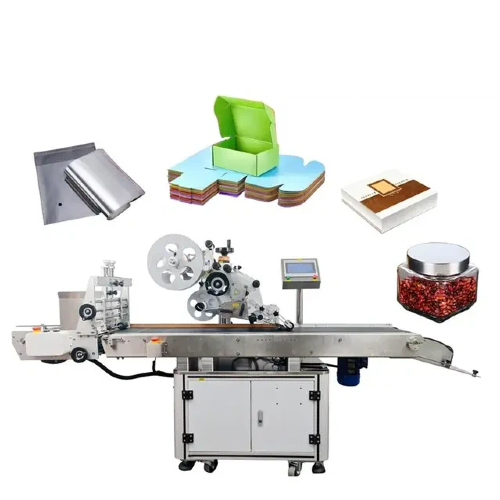
Understanding the components of a flat surface labeling machine helps operators and decision-makers select the right equipment for their production needs.
The conveyor system is responsible for transporting products smoothly through the labeling station.
Component | Function | Importance |
Conveyor belt | Moves products through the machine | Ensures continuous, uninterrupted flow for accurate labeling |
Guide rails | Aligns products to the correct position | Prevents skewing or rotation that could result in label misplacement |
Sensors | Detect product presence and position | Activates the label applicator at the precise moment to maintain accuracy |
Conveyor speed must be adjustable to accommodate varying production volumes and product sizes. Proper alignment is critical; even minor deviations can lead to misapplied labels, wasting material and requiring rework. Advanced conveyor systems include variable speed motors and integrated sensors to synchronize product movement with the labeling process.
The label applicator is the core component that applies the label to the product surface. It may operate using:
Roller application: Applies labels through mechanical pressure for smooth adhesion.
Tamp application: Uses a soft pad or tamping mechanism to press labels onto flat surfaces accurately.
Air-blow application: Employs controlled air pressure to place labels without contact, suitable for delicate or lightweight products.
The applicator ensures that labels adhere securely without wrinkles, bubbles, or misalignment. Modern machines allow precise adjustment of label placement, speed, and pressure, accommodating various label sizes and materials.
Sensors and control systems provide the automation and accuracy necessary for consistent labeling. Key features include:
Optical or infrared sensors to detect product edges and positions
Programmable logic controllers (PLCs) that control applicator timing, conveyor speed, and label dispensing
Feedback mechanisms to correct minor deviations in real-time, ensuring each label is applied precisely
These components work together to reduce human intervention, improve accuracy, and allow operators to monitor the process efficiently.
Adjustable guides and rollers maintain product alignment during labeling, which is crucial for consistency. Features include:
Adaptable guides to accommodate different product heights, widths, and shapes
Rollers to ensure smooth contact between the label and product surface
Adjustable tension and positioning settings that enable flexibility without compromising accuracy
Proper configuration of guides and rollers ensures that products remain stable during labeling, minimizing errors and material waste.
Selecting the ideal flat surface labeling machine requires careful evaluation of multiple factors:
The machine must handle the full range of product dimensions, including height, width, and depth.
Adjustable guides and rollers are critical for flexibility across multiple product lines.
The surface must be stable to achieve consistent label application.
Labels may be paper, plastic, or transparent, and the machine must accommodate each type.
Consider adhesive strength, thickness, and flexibility of the label material.
Applicator type must be compatible with the label material to ensure smooth and precise application.
Determine the required labeling rate to match production needs.
Decide between semi-automatic and fully automatic machines based on volume and staffing.
Ensure the labeling machine speed integrates seamlessly with the rest of the production line to avoid bottlenecks.
High-precision labeling is essential for branding and regulatory compliance.
Sensor quality and control system sophistication determine the machine’s accuracy.
Evaluate the acceptable tolerance range for label placement and choose a machine accordingly.
Machines should allow easy cleaning and maintenance, especially when switching products.
Reliable technical support and access to spare parts reduce downtime.
Regular maintenance schedules help maintain consistent performance and extend machine lifespan.
Proper selection offers multiple benefits:
Increased Production Efficiency: Automated labeling reduces manual labor and accelerates production.
Consistent Quality: Every product receives the same high-quality label, maintaining professional standards.
Reduced Waste: Accurate labeling reduces misapplied labels and material loss.
Professional Appearance: Uniform labeling enhances product aesthetics and marketability.
Flexibility: Machines can accommodate different product sizes and label types without extensive modification.
These advantages make the right flat surface labeling machine an indispensable tool for modern manufacturers seeking high-quality, efficient production.
Even high-quality machines face operational challenges. Understanding them allows operators to maintain efficiency.
Wrinkled or bubbled labels due to improper pressure or alignment
Misaligned products on the conveyor causing label placement errors
Mismatch between labeling speed and production line speed
Regular calibration of sensors and adjustment of guides
Proper conveyor alignment and speed optimization
Routine maintenance of applicators, rollers, and belts
Periodic quality checks to detect early issues and prevent batch errors
Proactive maintenance and careful configuration ensure long-term reliability and consistent labeling performance.
Modern flat surface labeling machines often incorporate eco-friendly and safety-conscious features:
Precision application reduces material waste
Compatibility with recyclable or biodegradable labels supports sustainable practices
Energy-efficient motors reduce electricity consumption
Safety features include:
Emergency stop buttons and protective guards around moving components
Operator training to handle adjustments safely
Clear instructions and routine inspections to minimize risk
Choosing the right flat surface labeling machine is essential for manufacturers who prioritize efficiency, accuracy, and consistent product presentation. By carefully evaluating factors such as product size, label type, production speed, and maintenance requirements, businesses can select a machine that meets their specific operational needs. Properly implemented, these machines minimize labeling errors, reduce material waste, and streamline the overall production workflow, ensuring every product looks professional and meets quality standards.
For manufacturers looking to enhance labeling efficiency and maintain high-quality production, Dongguan Chuyuanhui Packing Material Co., Ltd. (EPACK) offers a comprehensive range of flat surface labeling machines and packaging solutions. Their equipment is designed to handle a variety of product sizes and label types, providing reliable performance for both small-scale and high-volume operations. With expert technical guidance and dedicated support, EPACK helps businesses optimize their labeling processes, improve consistency, and achieve professional results across all production lines.
Manufacturers seeking to improve labeling accuracy and operational efficiency are encouraged to reach out to EPACK’s team for personalized consultation and tailored solutions that fit their production requirements.
They are ideal for boxes, cartons, trays, envelopes, and other flat or slightly curved surfaces.
Yes, they can apply paper, plastic, and transparent labels. The applicator must be compatible with the adhesive and material.
Production speed should match your labeling volume and integrate seamlessly with your production line.
Routine cleaning and part replacement are required, but modern machines are designed for easy access and maintenance.
Flat surface machines focus on planar products, cylindrical machines handle round containers, and right-angle machines label products at 90-degree edges.

