
- All
- Product Name
- Product Keyword
- Product Model
- Product Summary
- Product Description
- Multi Field Search
Views: 0 Author: Site Editor Publish Time: 2025-11-12 Origin: Site


In modern manufacturing and packaging industries, labeling machines play a crucial role in automating the process of applying labels to products. Labels not only provide essential information such as branding, instructions, and compliance details but also serve as a key element of product marketing and identification. Efficient labeling ensures that products are visually appealing, correctly marked, and ready for distribution with minimal human intervention.
Among the various types of labeling machines, the right-angle labeling machine is specifically designed to handle products that require labels to be applied at a precise 90-degree angle. This machine is particularly useful for items that cannot be labeled accurately using standard vertical or horizontal labeling systems. Its specialized design allows for consistent, high-quality labeling across production lines with complex product orientations.
By integrating automation, precise control, and versatile operation, right-angle labeling machines significantly reduce labor costs, enhance production speed, and maintain uniform labeling quality. Additionally, these machines often incorporate sensors and feedback systems that detect errors in real-time, ensuring minimal waste and consistent output. In this article, we will provide a comprehensive overview of how a right-angle labeling machine works, its components, workflow, advantages, selection criteria, common issues, and essential maintenance practices.
A right-angle labeling machine is a specialized system that applies labels to products at a 90-degree angle relative to their surface. Unlike standard labeling machines that primarily handle flat or vertical surfaces, right-angle machines are engineered for products with corners, edges, or non-standard shapes that require precise orientation.
Precise 90-degree labeling: Ensures the label is perfectly aligned even on challenging surfaces, preventing misplacement or misalignment.
Versatility: Can handle a wide range of product shapes, including square, rectangular, cylindrical, or irregular containers.
Automation and consistency: Reduces human errors and ensures labels are consistently applied in every batch.
Pharmaceuticals and medical packaging
Beverage bottles, cartons, and cans
Cosmetic and personal care containers
Electronics and small hardware packaging
The primary advantage of a right-angle labeling machine is its ability to maintain alignment integrity, which is essential for industries requiring high precision and standardized labeling practices.
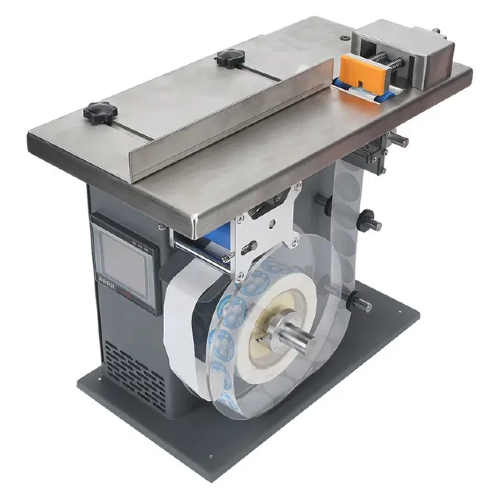
A right-angle labeling machine consists of multiple integrated components working together to ensure accurate and reliable label application. Understanding these components helps operators optimize the machine’s performance and identify potential maintenance needs.
The conveyor system is the backbone of the labeling process, transporting products from the feeding point to the output. Key features include:
Adjustable conveyor speed to match the production line rate
Guide rails that ensure consistent product alignment
Sensors that detect product presence and trigger the labeling process
Proper conveyor design prevents misalignment and ensures each product reaches the label applicator precisely positioned, which is critical for 90-degree labeling accuracy.
Component | Function | Importance |
Conveyor belt | Transports products through the machine | Ensures smooth and continuous movement without disruption |
Guide rails | Align products to maintain a 90-degree orientation | Prevents skewing or rotation that could misplace labels |
Sensors | Detect product presence and position | Activates the labeling applicator at the exact moment for precision |
The label applicator is responsible for dispensing and applying the label accurately to the product surface. Its operation depends on the type of applicator used:
Roller or tamp-blow system: Transfers labels using mechanical pressure or air-assisted placement
Pressure-sensitive application: Ensures labels adhere without air bubbles, wrinkles, or peeling
Servo-controlled movement: Provides precise control over the speed, angle, and position of label application
The choice of applicator affects the accuracy, speed, and versatility of labeling, particularly for products with varied shapes or delicate surfaces.
Sensors and control systems maintain operational accuracy by continuously monitoring the machine’s functions:
Optical sensors detect product edges and label placement points
Programmable logic controllers (PLCs) regulate conveyor speed, applicator timing, and label dispensing
Feedback systems allow the machine to correct misalignment in real-time
A well-calibrated control system ensures labels are consistently applied even at high production speeds, minimizing waste and rework.
Adjustable guides and rollers are essential for handling products of different sizes and shapes:
Guides maintain proper orientation and prevent rotation during labeling
Rollers ensure smooth contact between the label and the product surface
Adjustable settings accommodate various heights, widths, and shapes, enabling versatile operation without the need for additional equipment
Understanding the step-by-step operation of a right-angle labeling machine provides insight into its efficiency and precision.
Products are introduced to the conveyor either manually or automatically. Correct positioning on the conveyor is critical for ensuring the label is applied at the correct 90-degree angle. Misaligned feeding can lead to label placement errors or product damage.
The machine uses guide rails, adjustable rollers, and sensors to align each product accurately. Proper alignment guarantees that the label will contact the product surface precisely where intended.
During label application:
The applicator dispenses the label from a roll or sheet, ensuring smooth unwinding.
Rollers, tampers, or air jets press the label firmly onto the product surface, conforming to corners and edges.
Sensors verify correct application and detect errors such as wrinkles, bubbles, or misalignment.
Some right-angle labeling machines feature advanced quality control systems:
Optical sensors or cameras check for label placement accuracy
Real-time detection allows for immediate correction or rejection of misapplied labels
Ensures consistent high-quality labeling across all products
Labeled products exit the machine in a neat, organized manner, ready for packaging, shipping, or subsequent processing. Smooth output prevents jams and ensures seamless integration with other production line equipment.
Step | Function | Key Components |
Feeding | Introduce products | Conveyor belt, feed guides |
Alignment | Position products | Sensors, adjustable guides |
Labeling | Apply labels | Label applicator, rollers, tampers |
Verification | Check accuracy | Optical sensors, cameras |
Output | Move labeled products | Conveyor system, collection tray |
The use of a right-angle labeling machine offers numerous advantages for industrial production:
High Precision Labeling: Ensures every label is correctly positioned, enhancing the professional appearance of the product.
Adaptability to Various Shapes: Can handle square, rectangular, cylindrical, and irregular products without compromising accuracy.
Increased Production Efficiency: Automated operation reduces manual labor, increases throughput, and supports high-volume production.
Consistency Across Batches: Guarantees uniform labeling, critical for compliance, branding, and customer satisfaction.
Cost Reduction: Minimizes label wastage and reduces errors, ultimately lowering operational costs.
By providing a combination of speed, accuracy, and versatility, right-angle labeling machines improve overall production line performance while maintaining product quality.
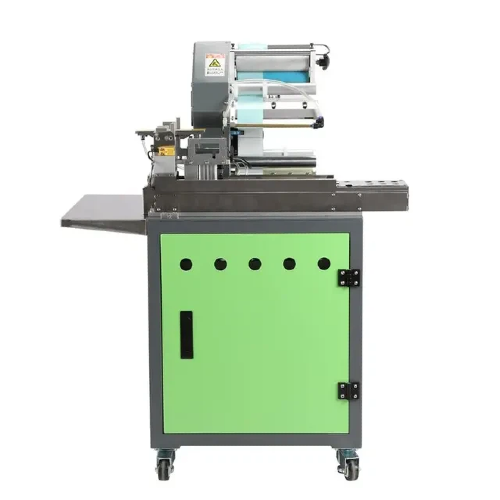
When selecting a right-angle labeling machine, several factors should be carefully evaluated:
Factor | Description | Recommendation |
Product Shape & Size | Ensure the machine accommodates your product dimensions | Check adjustable guides and applicator reach |
Label Type | Paper, plastic, or transparent labels | Confirm applicator compatibility and adhesive type |
Automation Level | Semi-automatic vs fully automatic | Match to production volume and workforce availability |
Production Speed | Labels per minute | Align with line throughput requirements |
Maintenance & Support | Ease of cleaning, part replacement, and technical support | Choose a supplier offering comprehensive service and support |
Proper selection ensures reliable operation, minimizes downtime, and maximizes return on investment.
Even advanced labeling machines may encounter operational challenges. Regular maintenance helps prevent downtime and prolongs machine life.
Labels wrinkling or forming air bubbles
Misaligned labels due to improper conveyor speed or guide settings
Sensor or applicator malfunction affecting label placement
Conveyor jams or inconsistent product feeding
Clean rollers, guides, and applicators regularly to prevent adhesive buildup.
Calibrate sensors and applicators periodically to maintain accuracy.
Replace worn belts, rollers, or tampers according to manufacturer recommendations.
Conduct routine quality checks to ensure all labels are applied correctly.
Proper maintenance not only extends the machine’s service life but also ensures high-quality labeling output.
Modern labeling machines often integrate eco-friendly features to reduce environmental impact:
Precision label application reduces label waste
Compatibility with recyclable or biodegradable labels supports sustainable packaging
Energy-efficient motor systems lower electricity consumption
Safety measures are also crucial:
Emergency stop buttons and safety guards around moving parts prevent accidents
Operator training ensures safe handling of the machine and adjustment procedures
Clear signage and routine inspections further enhance operational safety
A right-angle labeling machine is an essential solution for manufacturers who require precise 90-degree labeling on a variety of product shapes. By combining conveyors, sensors, label applicators, and advanced control systems, these machines deliver consistent, high-quality labeling while minimizing human intervention, reducing errors, and improving overall production efficiency. Automated alignment, accurate application, and quality verification make these machines a critical component in modern packaging operations.
For manufacturers aiming to enhance labeling accuracy and streamline their production lines, Dongguan Chuyuanhui Packing Material Co., Ltd. (EPACK) provides a comprehensive range of right-angle labeling machines and related packaging solutions. Their equipment is designed to meet diverse operational needs, whether for small-scale production or high-volume manufacturing, and comes with professional guidance to ensure optimal performance.
Businesses interested in boosting labeling efficiency and maintaining a professional, consistent product presentation are encouraged to reach out to EPACK. By consulting with their team, manufacturers can find tailored solutions that fit their production requirements and achieve reliable, high-quality labeling results.
It can label square, rectangular, cylindrical, and irregular products, providing flexibility for different packaging needs.
Some advanced models are capable of dual-side labeling, allowing labels to be applied to multiple surfaces at 90-degree angles.
Yes, most machines handle paper, plastic, and transparent labels. Adhesive type and label thickness should be compatible with the applicator mechanism.
Routine maintenance is recommended weekly, with full inspection and part replacement quarterly or as specified by the manufacturer.
A right-angle labeling machine applies labels at precise 90-degree angles for products with corners or edges, whereas standard machines typically handle flat or vertical surfaces only.

