
- All
- Product Name
- Product Keyword
- Product Model
- Product Summary
- Product Description
- Multi Field Search
Views: 0 Author: Site Editor Publish Time: 2026-11-09 Origin: Site


Protective packaging choices directly impact your warehouse footprint, shipping rates, and labor efficiency. Couriers use dimensional weight pricing to calculate final shipping costs. This calculation heavily punishes oversized or bloated packages. For decades, traditional pre-inflated bubble wrap was the default industry standard. Today, modern e-commerce and 3PL fulfillment centers are shifting toward on-demand solutions. Shippers need scalable methods to protect goods without wasting valuable warehouse space.
This guide provides a direct, operational comparison between air bubble film and traditional bubble wrap. We evaluate both materials on storage scalability, labor throughput, and transit protection. You can confidently determine the exact right fit for your unique shipping volume. By analyzing these packaging strategies, you will uncover hidden operational bottlenecks. You will also learn how to optimize your packing stations for maximum efficiency and better customer unboxing experiences.
Inefficient packaging drives up courier costs rapidly. Carriers like FedEx, UPS, and USPS utilize dimensional weight (DIM) pricing. They calculate shipping fees based on package volume rather than just actual weight. Excess bulk from traditional padding often forces shippers to use larger boxes. You essentially pay to ship empty space. Moving to a leaner protective material minimizes box sizes. It directly lowers per-package transit fees. Modern supply chains cannot afford to ignore volumetric penalties.
Warehouse space comes at a premium. Storing traditional pre-inflated rolls introduces a massive hidden cost. We call this storing "dead air." Massive bags of pre-filled bubbles consume valuable square footage. You could otherwise use this space for revenue-generating inventory. Facility managers must calculate the true cost per square foot allocated to packaging supplies. By reducing the physical footprint of your materials, you free up essential racking space. You also eliminate cluttered aisles and improve overall facility navigation.
Manual packing processes create severe operational bottlenecks. Packers spend significant time unrolling, measuring, and cutting traditional sheets. This repetitive motion causes packer fatigue. It drastically slows down fulfillment speed. Alternatively, automated dispensers release precise, perforated lengths of film. Operators simply grab and tear. High-volume environments depend on standardizing pack times. Ergonomic improvements reduce workplace strain and directly boost daily throughput metrics. Efficiency at the packing bench sets the pace for the entire shipping dock.
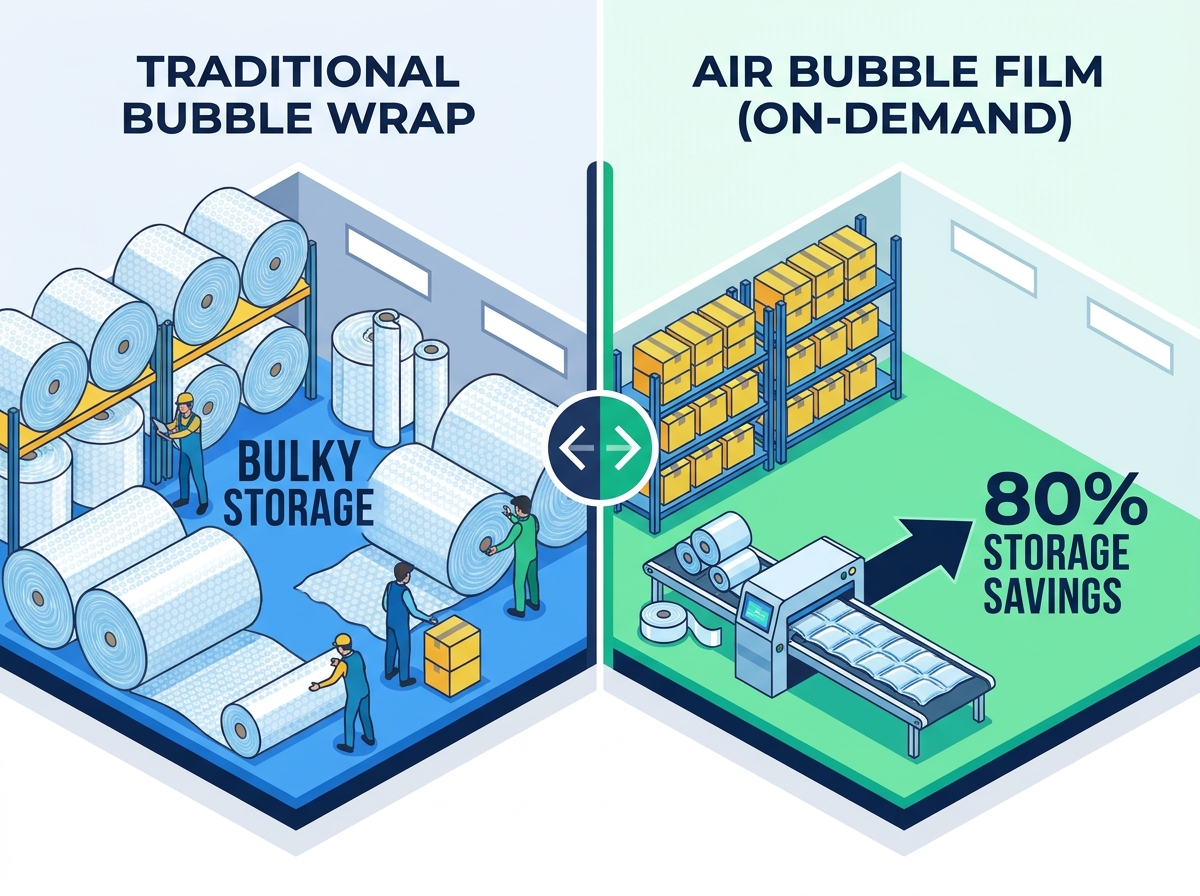
Traditional bubble wrap consists of pre-inflated polyethylene sheets. Manufacturers seal air into small hemispheres between two plastic films. These sheets arrive at your facility fully inflated. They are ready to use immediately out of the delivery truck. Shippers typically buy them in massive rolls or large dispenser boxes.
Traditional wrap remains highly relevant for specific scenarios. It requires absolutely zero capital expenditure. You do not need to buy, lease, or maintain machinery. Any packer can grab a roll and start working immediately.
The primary drawback is its massive storage footprint. Pre-inflated materials take up an enormous amount of space. You also incur high inbound freight costs. You are essentially paying transport companies to ship air to your facility. From an operational standpoint, the manual packing process is inherently slower. Hand-cutting sheets leads to inconsistent material usage. Packers often over-wrap items "just to be safe," wasting materials.
This legacy material best serves low-volume shippers. Niche manufacturing companies shipping a few highly valuable items weekly rely on it heavily. Specialized moving companies also prioritize it. They need adaptable materials to wrap individual household items on-site. If your business prioritizes bespoke, individual item wrapping over high-speed fulfillment, traditional wrap remains a solid choice.
Air bubble film arrives at your facility completely flat. Suppliers ship it as high-density rolls of plastic film. Packers feed these flat rolls into an on-demand inflation machine right at the workstation. The machine quickly injects ambient air into the pockets and heat-seals the edges. This process creates robust protective cushions instantly.
Space efficiency drives the adoption of on-demand systems. A single pallet of uninflated air bubble film can yield an astonishing amount of padding. It often produces the equivalent protective volume of an entire truckload of traditional rolls. Facilities reclaim vast areas of floor space previously dedicated to supply storage. You can convert this reclaimed space into active picking zones. Better space utilization directly impacts your bottom line.
Modern inflation machines dispense padded sections at high speeds. Many machines output dozens of feet per minute. The material features built-in perforations. Packers do not need scissors or safety knives to separate the sheets. They simply pull and tear along the line. This standardizes pack times across your entire workforce. It also reduces packer hand fatigue during long shifts. Automation streamlines the workflow beautifully.
Engineers design modern on-demand materials to be remarkably lightweight yet durable. They utilize co-extruded layers of plastic. This multi-layer construction provides high burst strength. The cushions withstand significant pressure without popping. They brace heavy industrial items effectively. Because the material is so light, it adds practically zero ounces to your final shipping scale. You get superior shock absorption without the extra weight penalty.
Packaging Solutions Performance Matrix
| Evaluation Metric | Traditional Bubble Wrap | On-Demand Air Film |
|---|---|---|
| Storage Footprint | Extremely High | Minimal (Flat Rolls) |
| Initial Equipment Cost | Zero | Requires Machine Investment/Lease |
| Packing Speed | Slower (Manual cutting) | Fast (Automated dispensing) |
| Best Application | Wrapping intricate, delicate items | Void fill, blocking, and bracing |
| Ideal Volume | Low (<50 packages/day) | Medium to High (>50 packages/day) |
You must assess shock absorption based on your product types. Traditional wrap excels in localized surface protection. It molds perfectly to sharp corners and odd shapes. However, its small bubbles sometimes compress under heavy weight. On-demand air cushions excel in different areas. They are superior for bracing, blocking, and void fill. Large air pillows lock products firmly in place within the carton. Their co-extruded layers resist punctures from heavy, shifting goods. Match the protection style to your specific transit hazards.
Consumer perception matters greatly. Buyers increasingly scrutinize unboxing experiences. Massive sheets of legacy plastic frustrate consumers during disposal. Conversely, deflating a single air pillow is simple. The end-user just pokes a hole in it, reducing waste volume instantly. Many modern air bubble film options feature eco-friendly designs. Suppliers offer biodegradable, highly recyclable, or PCR (post-consumer recycled) variants. Transitioning to on-demand materials visually demonstrates your commitment to lean, sustainable practices.
Integrating inflation machines into your layout requires careful planning. Smaller operations benefit from benchtop inflators. These compact units sit directly on the packing table. They produce material precisely when the packer needs it. Enterprise fulfillment lines require robust setups. They often utilize overhead hopper systems. A centralized heavy-duty machine inflates the film and blows it into an overhead netting system. Packers simply pull material down from gravity-fed dispensers. Choose the setup that matches your daily order volume.
You must address potential machine downtime. Equipment occasionally fails. What happens when the inflator jams during a peak holiday rush? Production grinds to a halt. Facility managers must mitigate this risk proactively. Keep a small backup supply of traditional materials on hand. Alternatively, partner with suppliers who offer rapid machine replacement guarantees. Preventative maintenance is crucial. Clean the heat sealers regularly to prevent film jams and ensure consistent air retention.
Introducing new equipment involves a short learning curve. You must train packers to calibrate the machine correctly. Poor calibration leads to defective packaging.
Decision-making relies on volume thresholds. If you ship more than 50 packages a day, you are a prime candidate for automation. If your warehouse space costs exceed standard industry thresholds, holding massive plastic rolls makes zero financial sense. Shippers hitting these marks realize significant process improvements almost immediately upon transitioning to modern inflation systems. Evaluate your daily output to justify the system upgrade.
The choice between modern on-demand systems and traditional sheets comes down to three factors. You must evaluate your shipping volume, available warehouse space, and desire for workflow automation. Protective packaging is not just an afterthought; it is a critical operational lever.
A: It does not have to. While you can purchase machines outright, many suppliers offer equipment leasing. Some even provide placement programs. In these programs, the machine is free as long as you commit to a minimum monthly film purchase. This significantly lowers the barrier to entry.
A: Yes, when properly calibrated. Modern co-extruded films offer excellent burst strength and puncture resistance. They hold up exceptionally well during transit, making them entirely suitable for bracing heavy industrial goods or consumer electronics.
A: Flat on-demand film is generally greener. Because it ships flat, it requires significantly fewer trucks to transport to your facility, lowering carbon emissions. Both materials are typically plastic (HDPE/LDPE) and require proper store drop-off recycling. However, deflated cushions create far less waste volume for the consumer.
A: While some small-quilt variations mimic legacy wrap for surface protection, larger pillows are strictly for void fill and block-and-brace applications. If you need tight, intricate wrapping for highly fragile items, traditional sheets remain superior.


