
- All
- Product Name
- Product Keyword
- Product Model
- Product Summary
- Product Description
- Multi Field Search
Views: 0 Author: Site Editor Publish Time: 2025-11-19 Origin: Site


In modern manufacturing and packaging industries, labeling machines play a vital role in ensuring product quality, efficiency, and brand recognition. Labels are not merely decorative; they provide critical information such as product details, usage instructions, safety warnings, barcodes, and regulatory compliance. Accurate labeling is essential for consumer trust, legal requirements, and a professional product appearance.
Among the various types of labeling machines, the round bottle labeling machine is designed specifically for cylindrical or round containers. This type of machine is widely used in sectors such as beverages, pharmaceuticals, cosmetics, chemicals, and food products, where bottles of different materials, sizes, and shapes require precise labeling. The adoption of a round bottle labeling machine improves efficiency, reduces manual labor, and ensures consistent label placement, ultimately enhancing brand image and operational productivity.
In this comprehensive guide, we will explore what a round bottle labeling machine is, its components, how it works, advantages, key factors to consider when choosing one, common challenges, and frequently asked questions. Understanding these aspects will help manufacturers select the right equipment for their production needs.
A round bottle labeling machine is specialized equipment designed to apply labels accurately and efficiently to cylindrical or round containers. Unlike flat surface labeling machines, which focus on boxes and trays, or right-angle labeling machines, which handle edges or corners, round bottle labeling machines are optimized for continuous 360-degree labeling.
Precision: Ensures labels are applied consistently without misalignment or skewing.
Automation: Reduces human intervention, allowing high-speed labeling with minimal error.
Versatility: Compatible with glass, plastic, and metal bottles of various sizes.
Flexibility: Can handle different label types, including paper, plastic, and transparent materials.
Beverage bottles such as water, juice, soda, and alcoholic drinks
Cosmetic bottles for creams, serums, and essential oils
Pharmaceutical bottles containing pills, syrups, or supplements
Industrial chemicals in small or medium-sized bottles
Round bottle labeling machines are essential for industries requiring high-volume production with consistent labeling accuracy, reducing waste and improving the overall efficiency of packaging lines.
Understanding the components of a round bottle labeling machine is crucial for evaluating its suitability for your production requirements.
The conveyor system transports bottles through the labeling station smoothly and consistently.
Component | Function | Importance |
Conveyor belt | Moves bottles | Ensures continuous flow for precise labeling |
Guide rails | Aligns bottles | Prevents tilting or misalignment |
Sensors | Detect bottle position | Triggers applicator at the correct moment |
Conveyor speed is typically adjustable to accommodate varying production volumes and bottle sizes. Proper alignment of the conveyor and bottles is essential for achieving accurate label placement.
Bottle holders or grippers secure bottles during labeling to prevent slipping or tilting. Features include:
Adjustable grippers to accommodate different bottle diameters
Soft or cushioned surfaces to prevent damage to fragile containers
Mechanisms to rotate bottles steadily for 360-degree label application
The label applicator is the component that directly applies the label to the bottle. Common types include:
Roller applicators: Use mechanical rollers to press labels onto the bottle surface.
Tamp applicators: Employ a pad to press labels accurately onto the bottle.
Air-blow applicators: Use air pressure to position and attach labels gently.
A high-quality applicator ensures smooth, wrinkle-free, and bubble-free labeling. Modern machines often allow precise control over label speed, pressure, and placement.
Sensors and control systems automate the labeling process:
Optical sensors detect bottle edges and rotation position.
Programmable Logic Controllers (PLCs) control timing, conveyor speed, and label dispensing.
Feedback systems adjust label placement in real-time to correct minor misalignments.
Automation improves speed, reduces errors, and allows operators to focus on quality control rather than manual application.
The rotary mechanism rotates bottles during labeling to enable 360-degree coverage:
Provides consistent rotation for precise full-wrap labels
Works in tandem with applicators to maintain proper tension and adhesion
Adjustable for different bottle diameters and label lengths
This mechanism is critical for achieving uniform labeling on round containers, particularly for high-speed production lines.
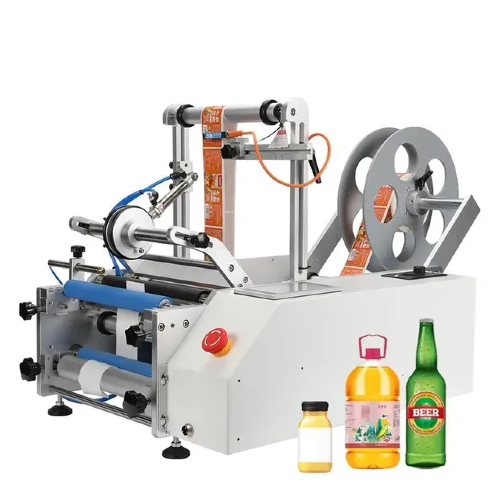
Understanding the operational workflow of a round bottle labeling machine helps in evaluating its performance and suitability.
Bottles are fed into the machine either manually or through an automatic feeding system.
Guide rails and sensors ensure each bottle is properly aligned and stabilized.
The machine positions the bottle accurately to prepare for rotation and labeling.
Labels are applied using roller, tamp, or air-blow mechanisms, depending on the machine type and product requirements.
The bottle rotates steadily while the applicator applies the label, achieving a smooth, full-wrap coverage.
For multi-label applications, machines can apply front, back, or sleeve labels in a single pass.
Sensors detect proper label placement, adhesion, and completeness.
Misaligned or missing labels trigger automatic rejection or correction processes.
Real-time monitoring ensures consistency across the production line.
Labeled bottles are transported to the next stage, such as packaging, capping, or boxing.
The conveyor ensures orderly output, maintaining production efficiency and preventing bottle collisions.
Investing in a round bottle labeling machine provides numerous benefits:
Enhanced Production Efficiency: Automation allows high-speed labeling without additional labor.
High Accuracy: Rotating mechanisms and precise applicators reduce label misalignment.
Reduced Waste: Proper alignment and application minimize wasted labels and adhesives.
Versatility: Capable of labeling various bottle types and sizes, adapting to different production needs.
Professional Appearance: Ensures consistent labeling quality, improving product aesthetics and brand image.
Cost-Effective Over Time: Reduced manual labor, error rates, and material waste contribute to long-term savings.
These advantages make round bottle labeling machines essential for manufacturers aiming for quality, efficiency, and scalability.
Selecting the right machine requires careful consideration of several factors:
Machines must accommodate the full range of bottle diameters and heights.
Smooth or textured surfaces may require different applicator types.
Adjustable grippers and guides enhance flexibility for multiple bottle lines.
Labels can be paper, plastic, or transparent with various adhesives.
Machine compatibility with label material ensures proper adhesion and smooth application.
Consider label length, width, and flexibility when selecting a machine.
Determine the number of bottles labeled per minute.
Semi-automatic machines suit lower volumes, while fully automatic machines handle high-volume production.
Integration with upstream and downstream processes is essential for optimal throughput.
High-precision labeling is critical for brand consistency and regulatory compliance.
Sensor quality, applicator type, and rotary mechanism precision influence labeling accuracy.
Tolerance for positioning errors should align with product standards.
Ease of cleaning, part replacement, and machine adjustments is vital.
Access to technical support and spare parts ensures minimal downtime.
Regular maintenance improves machine longevity and consistent performance.
Even advanced round bottle labeling machines face operational challenges:
Wrinkled or bubbled labels
Bottles slipping or rotating unevenly
Machine speed mismatched with production line
Adhesive inconsistencies
Calibrate sensors and adjust guide rails regularly
Optimize rotary mechanism rotation speed and applicator pressure
Maintain conveyors and rollers for smooth bottle transport
Perform periodic inspection of label stock and adhesive quality
Proactive maintenance, proper calibration, and operator training are critical for maintaining consistent labeling quality.
Modern machines integrate environmentally friendly and safety-conscious features:
Reduced label and adhesive waste
Compatibility with recyclable or biodegradable labels
Energy-efficient motors and low-noise operation
Safety features include:
Emergency stop buttons and protective guarding
Clear operating instructions and training for operators
Regular inspection of moving components to prevent accidents
A round bottle labeling machine is a vital tool for manufacturers aiming for high-speed, precise, and professional labeling. By carefully considering factors such as bottle size, label material, production speed, and maintenance needs, businesses can select a machine that maximizes efficiency, minimizes errors, and ensures consistent labeling across all products. Properly integrated labeling systems not only streamline production workflows but also enhance brand presentation and product quality, making these machines a strategic investment for any modern packaging line.
For manufacturers looking to improve labeling performance and operational efficiency, Dongguan Chuyuanhui Packing Material Co., Ltd. (EPACK) provides a wide range of advanced round bottle labeling machines and comprehensive packaging solutions. Their machines are designed to handle various bottle sizes and label types while delivering reliable, high-precision results. With professional technical guidance and dedicated support, EPACK helps manufacturers optimize labeling processes, reduce downtime, and achieve consistent, high-quality output.
Businesses seeking to elevate their production standards and labeling accuracy are encouraged to reach out to EPACK for expert consultation and tailored solutions that match their specific operational requirements.
Glass, plastic, and metal bottles with cylindrical or slightly tapered shapes.
Yes, some machines can apply front, back, and sleeve labels in a single pass.
Yes, including paper, plastic, and transparent labels, depending on the applicator type.
Consider your required labeling volume and integrate with upstream and downstream processes.
Round bottle machines focus on cylindrical containers, flat surface machines handle boxes/trays, and right-angle machines label edges or corners.

